Your Trusted Real Estate Advisors. Let Us Help You!
Are We There Yet? Seven Rate Holds Later, Canada’s Housing Recovery Is Starting to Take Shape
For anyone waiting for the Canadian real estate market to finally turn a corner, the question has become a familiar one:
Are we there yet?
Not quite.
But there are some encouraging signs that we may finally be getting closer.
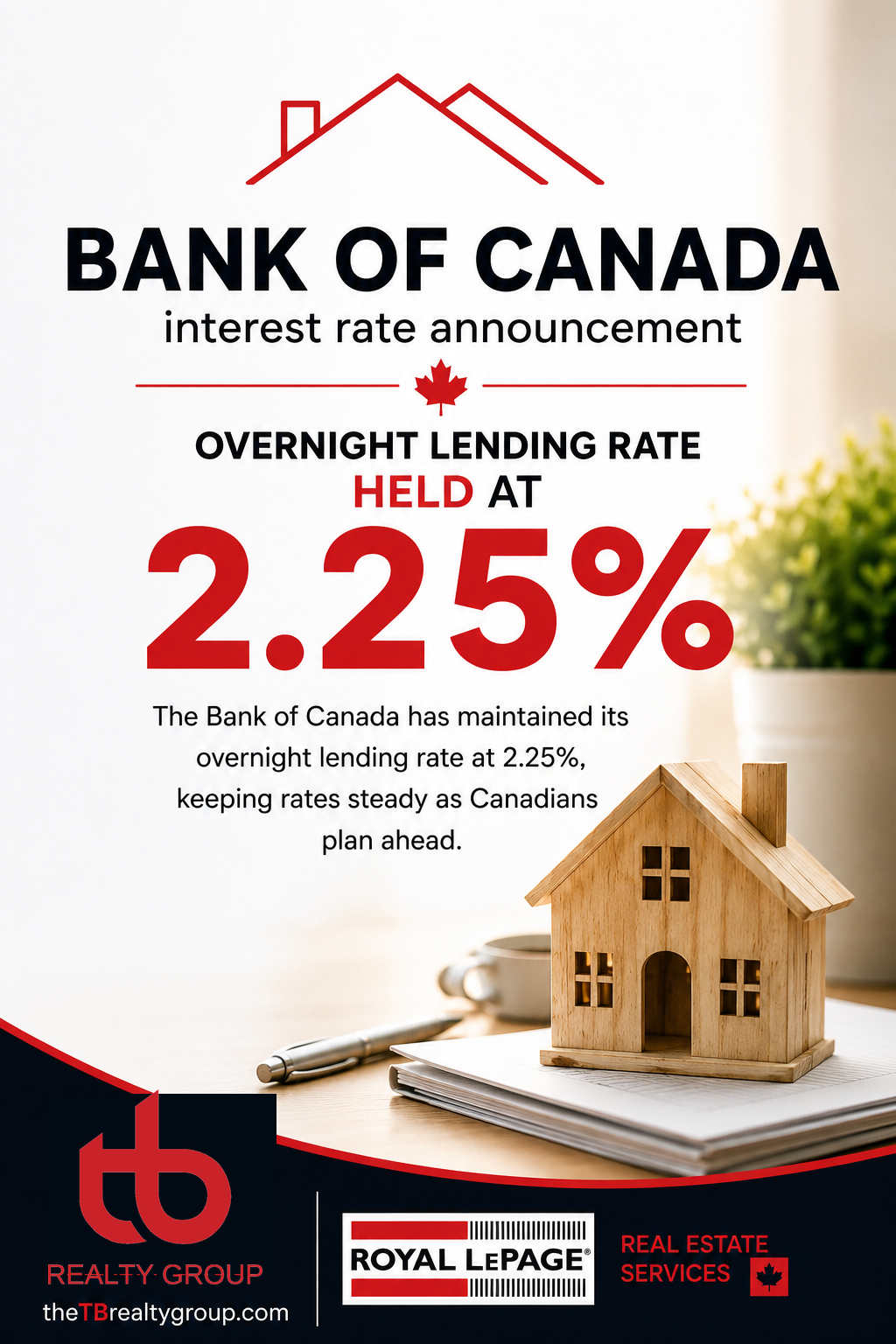
On September 2, the Bank of Canada held its overnight lending rate at 2.25%, marking the seventh consecutive rate announcement with no change.
At the same time, RBC Economics has released its mid year Canadian housing outlook with a particularly appropriate title: Between Correction and Recovery.
And when you put the two reports together, an interesting picture begins to emerge.
Why Didn’t the Bank of Canada Cut Rates?
Canada’s economy performed better than many expected during the second quarter.
GDP grew at an annualized rate of 3.3%, following very weak growth in the first quarter. Consumer spending increased, housing activity showed some improvement, and exports and business investment strengthened. The unemployment rate also edged down to 6.4% in July.
So why didn’t the Bank move?
Because there are still two significant forces pulling in opposite directions.
On one side, tariffs and continuing uncertainty surrounding Canada US trade could slow economic growth, investment and hiring.
On the other, higher energy prices are putting upward pressure on inflation.
That leaves the Bank of Canada with good reason to wait for more information before making its next move.
About That 3% Inflation Number
July’s headline inflation number of 3.0% sounds concerning at first glance.
But the number deserves some context.
The Bank says inflation has recently been hovering around 3% mainly because of persistently higher gasoline prices associated with the continuing Middle East conflict. When gasoline is removed, Canadian inflation was 2.2% in July.
The Bank’s measures of underlying inflation are also considerably calmer. CPI trim was 1.9% in July and CPI median was 2.0%.
That doesn’t mean inflation can be ignored. The Bank is specifically watching for signs that higher energy prices begin spilling over into the prices of other goods and services.
So far, it says there has been little evidence of that happening.
And Then There’s Housing
This is where things get particularly interesting.
RBC Economics believes Canada’s housing market is finally taking steps toward recovery.
Home resales have been improving since April, inventory has levelled off and prices appear to be stabilizing or declining more slowly. RBC expects the recovery to become more visible in 2027.
For 2026, RBC forecasts Canada’s benchmark home price will decline 2.3% to approximately $794,200.
For 2027, it forecasts the national benchmark price will edge up 0.8% to approximately $800,700, while transactions increase 6.7%.
Those aren’t boom market numbers.
And frankly, that may be a good thing.
A gradual recovery supported by improving affordability and genuine buyer demand would arguably be healthier than another rapid price surge.
Ontario Could Be One of the Stronger Comebacks
For those of us watching the GTA and surrounding markets, one RBC projection really stands out.
RBC expects Ontario transactions to increase 8.2% in 2027, following a projected 0.5% decline this year.
Ontario home values are also projected to edge approximately 0.7% higher next year.
There is an important exception: condos.
RBC believes abundant inventory in Toronto and Vancouver could keep condo prices under pressure, potentially into 2027.
That distinction matters enormously when we talk about “the market.” There isn’t one Canadian real estate market, and there isn’t even one GTA market. Detached homes, townhomes and condos can experience very different conditions at exactly the same time.
The Number That Really Caught Our Attention: 400,000
Perhaps the most interesting part of RBC’s report isn’t its price forecast at all.
It’s the buyers who haven’t bought yet.
RBC estimates that the formation of more than 400,000 Canadian households may have been suppressed since 2019.
These include people who postponed buying their first home, continued renting longer than they wanted, or delayed moving into a different home because ownership costs had become too high.
In other words, some housing demand hasn’t disappeared.
It has been delayed.
RBC believes unlocking that pent up demand could ultimately outweigh the reduction in housing demand caused by lower immigration.
That may prove to be one of the most important housing stories to watch over the next year.
So, Are We There Yet?
Not quite.
The Bank of Canada itself says Canada’s economic recovery is broadening, but it remains uncertain whether that recovery will be sustained. RBC similarly cautions that housing’s path forward probably won’t be smooth.
But we’re beginning to see some of the ingredients required for a healthier market.
Rates have been stable. Affordability has improved from its worst levels. Buyers who postponed moves haven’t necessarily disappeared. And Ontario could see a meaningful increase in transactions as confidence gradually returns.
For homeowners, the important question may no longer be simply “When will the market recover?”
It may be:
“What should I be doing now so I’m ready when it does?”
That’s a conversation worth having before everyone else decides the recovery has arrived.
Thinking about buying, selling or making a move in the next 12 to 18 months? Let’s talk about what today’s numbers actually mean for your particular neighbourhood, property and plans.